Solar Panel Roof Replacement in Montclair from $250. $250 to $350 a panel to take the array off and put it back -- and the order you do things in is worth $5,000. Free inspection and a written quote.
Large south-facing slopes on substantial houses make this the most likely place on this site to find a big array over a tired roof. It is also where the honest advice is hardest to hear: if the covering has five years left, doing it now while the array is off is cheaper than doing it twice.
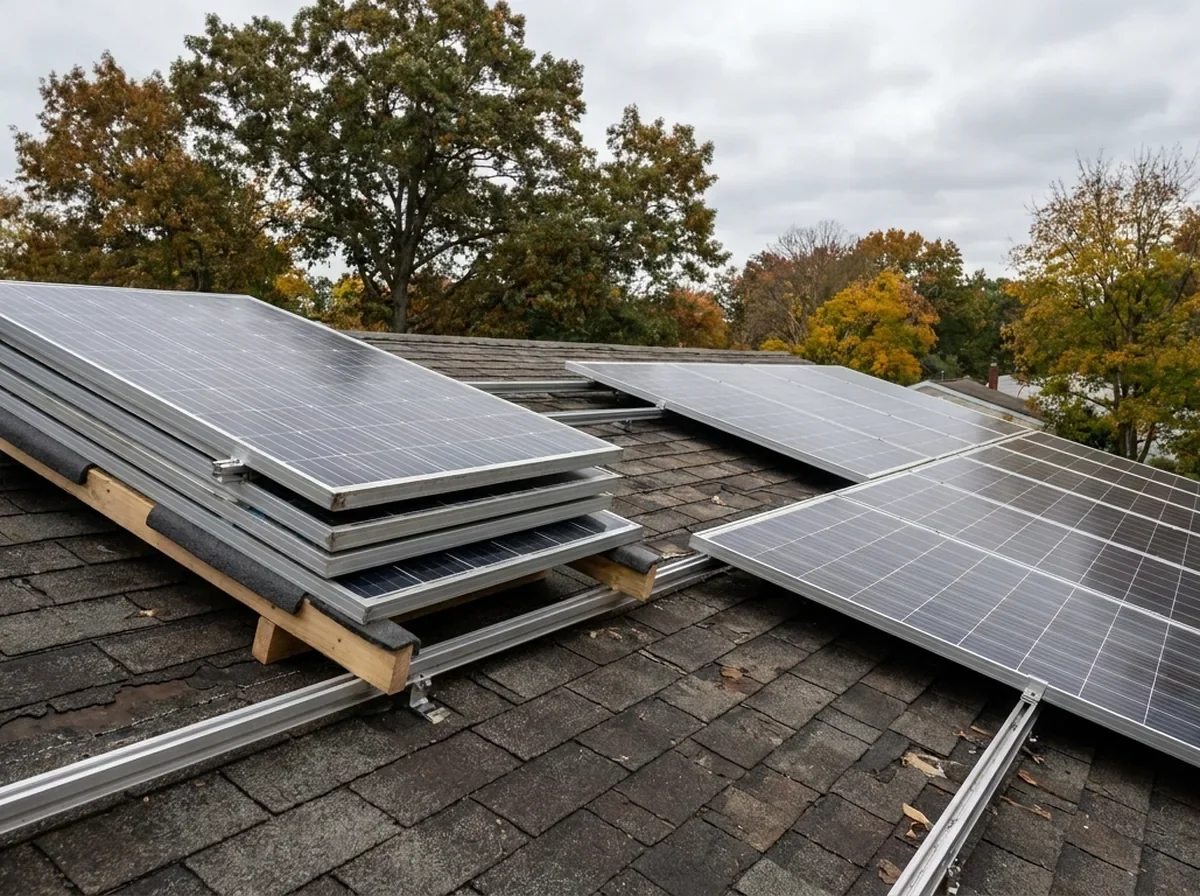
Removing a solar array so the roof under it can be replaced, and reinstalling it afterwards, costs $250 to $350 per panel in New Jersey. On a 26-panel system that is roughly $5,000 to $6,500, and across the normal range of residential systems $4,500 to $9,500. It adds four to seven days: a day to take the array down, two to five days of roofing, a day to put it back.


Removing a solar array so the roof underneath can be replaced, and reinstalling it afterwards, costs $250 to $350 per panel in New Jersey -- roughly $5,000 to $6,500 on a 26-panel system and $4,500 to $9,500 across the normal range of residential systems. It adds a day off, two to five days of roofing, and a day back. Assume the top of the ranges. Staging on a sloping plot, hand-formed detail on an ambitious roof, and a decent chance of a large array on the south-facing slope. A Montclair quote priced on area alone will be wrong by a wide margin.
If the covering has ten years left and the panels have not gone on yet, replace the roof first: the removal cost never happens. Doing it the other way round means paying five figures' worth of trades to undo work finished the year before.
Electrical disconnect, removal and labeling, secure storage while the roof is open, reinstallation on the new covering, reconnection, and a production check afterwards. A quote that does not list those has not scoped the work.
Panel count, because the price scales with panels and not roof area. A complicated roof where the mounting is spread across planes rather than run in clean rows. And a ballasted flat-roof system, which comes off differently from a pitched roof-mount.
The most expensive roofs covered on this site, and for reasons that have nothing to do with the covering. Sloping plots mean staging rather than ladders; ambitious roof shapes mean valleys, dormers and hand-formed detail; and solar arrays on large south-facing slopes are common enough that the removal cost should be assumed until checked.
Montclair and Halcyon Park are where this site's prices stop tracking roof area and start tracking the number of details on the roof.
Worth knowing before you start ringing round, particularly if there are panels involved.
Northern roofs fail at the edges in the freeze. Water backs up under the courses at the eaves, freezes, lifts them, and the ceiling below stains during the first thaw -- so the calls arrive in a cluster, in the same two weeks, and the roof that could have been done comfortably in September becomes an emergency in February.
Assume the top of every range here.
Ambitious roof shapes mean more valleys per square foot, and valleys are where shingle roofs fail.
On a sloping plot a flat roof frequently discharges onto ground that falls away from the house, which is good -- or towards it, which is not.
The most architecturally ambitious housing covered on this site, and the place where a roof is most likely to be a designed object rather than a covering.
On a sloping plot the garage is frequently built into the hill with one wall below grade, and that changes the diagnosis completely.
Detached township stock. Count the panels first.
Mixed use, flat roofs, parapets. Access first.
Pre-1940. Board sheathing and no ice barrier.
The biggest roofs, and the biggest arrays on them.
An 1895 planned district. Appearance is the brief.
Big Victorian roofs, and slate on a fair number.
Denser and more multi-family. Unit count decides it.
Asked on every job of this kind. Answered here.
On a small localized repair, sometimes. On a replacement, no -- the covering under the array has to come off, and that means the array comes off. Anybody offering to re-roof under panels in place is describing something other than a replacement.
A qualified electrician, not us. We do roofing. The removal price includes coordinating it and the production check afterwards, but the electrical work itself is a separate trade and the scope says so rather than blurring it.
No. The inspection is free, the written quote is free, and neither carries an obligation. The survey includes counting the array and giving you an honest estimate of how much life the covering has left, which is worth having even if you use somebody else. What we will not do is give you a number at the curb.
$250 to $350 per panel in New Jersey -- roughly $5,000 to $6,500 on a 26-panel system and $4,500 to $9,500 across the normal range of residential systems. That covers the electrical disconnect, removal and labeling, storage while the roof is open, reinstallation, reconnection and a production check. It adds four to seven days to the job.
An architectural asphalt roof runs $9,500 to $26,000, with most 2,000 square foot houses at $12,000 to $18,000 installed. Per square foot that is $5.50 to $8.00 for architectural and $4.50 to $6.50 for three-tab. If there is a solar array on the roof, add $4,500 to $9,500 and four to seven days.
Any array counted and priced separately, not buried in a rate. Both sequences costed, so the cheaper order is obvious.