Solar Panel Roof Replacement in Glen Ridge from $250. $250 to $350 a panel to take the array off and put it back -- and the order you do things in is worth $5,000. Free inspection and a written quote.
Complicated roof shapes make an array harder to remove and reinstate than a simple slope, because the mounting is spread across planes rather than run in clean rows. Expect the upper end of the per-panel range and ask for the figure in writing before the work is scheduled.
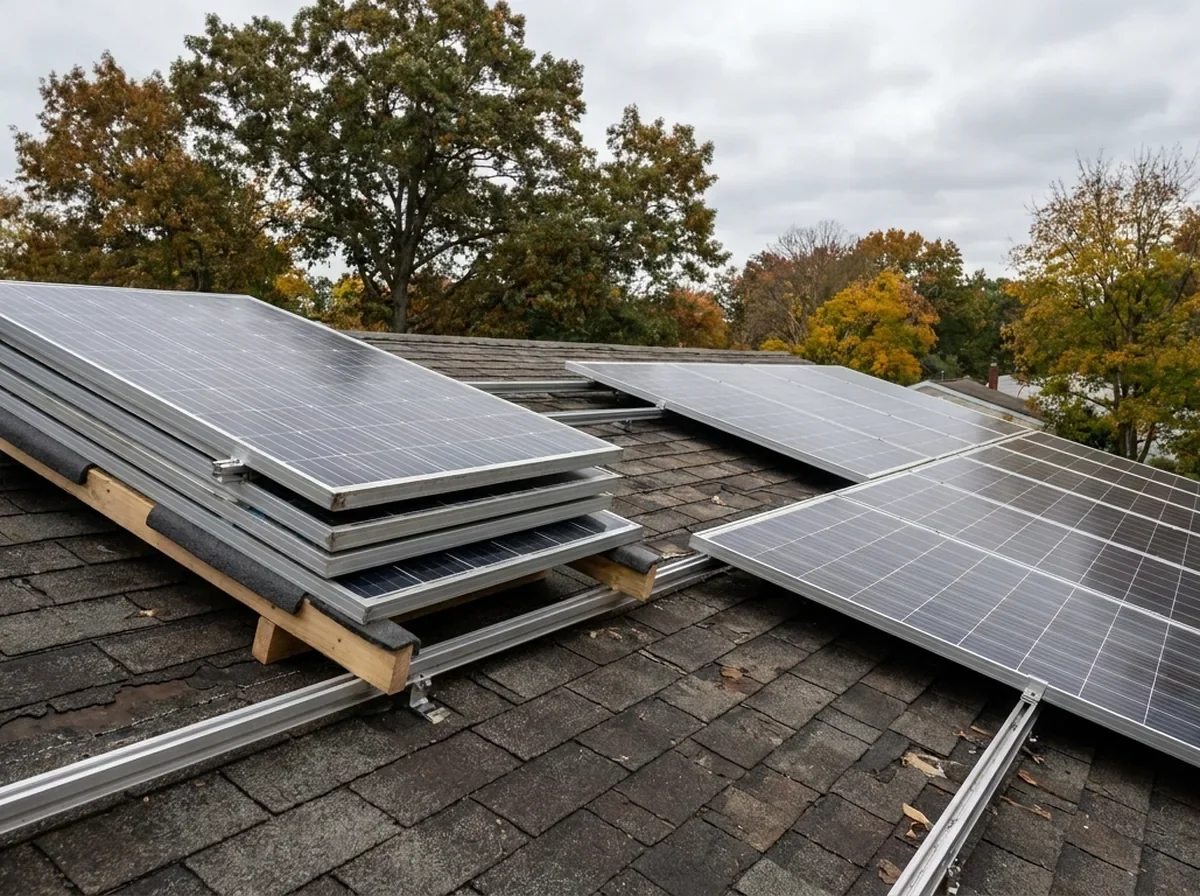
Removing a solar array so the roof under it can be replaced, and reinstalling it afterwards, costs $250 to $350 per panel in New Jersey. On a 26-panel system that is roughly $5,000 to $6,500, and across the normal range of residential systems $4,500 to $9,500. It adds four to seven days: a day to take the array down, two to five days of roofing, a day to put it back.


Removing a solar array so the roof underneath can be replaced, and reinstalling it afterwards, costs $250 to $350 per panel in New Jersey -- roughly $5,000 to $6,500 on a 26-panel system and $4,500 to $9,500 across the normal range of residential systems. It adds a day off, two to five days of roofing, and a day back. The upper end of every range, and usually for slate rather than solar. A slate roof that appears to be failing has often failed at the nails or the valley linings instead -- which is a repair, at a fraction of a replacement.
If the covering has ten years left and the panels have not gone on yet, replace the roof first: the removal cost never happens. Doing it the other way round means paying five figures' worth of trades to undo work finished the year before.
Electrical disconnect, removal and labeling, secure storage while the roof is open, reinstallation on the new covering, reconnection, and a production check afterwards. A quote that does not list those has not scoped the work.
Panel count, because the price scales with panels and not roof area. A complicated roof where the mounting is spread across planes rather than run in clean rows. And a ballasted flat-roof system, which comes off differently from a pitched roof-mount.
Large, complicated, older roofs: steep pitches, dormers, turrets on some houses, and slate on a fair number of them. That combination means detail work rather than area work, and a quote priced on square footage alone will be wrong. Permits, where needed, go to Glen Ridge and not Bloomfield.
If there is an array on the roof -- or about to be -- the sequence is worth roughly five thousand dollars, and nobody selling solar has a reason to mention it.
A covering with ten years left under panels about to be fitted should be replaced now, while the removal cost is zero. Do it in the other order and you pay a second set of trades to undo work finished the year before. This is the single most valuable sentence on this site.
Because the decision is no longer free, it is a schedule. Knowing the covering has three years rather than ten lets you plan the removal around it -- and lets you do any other roof work on the property in the same window.
On the roof itself the usual test applies: if the covering away from a leak still lies flat, holds its granules and is not brittle, the repair is the right job at $350 to $1,800 rather than a replacement at $9,500 and up.
Large Victorian roofs with steep pitches, dormers and a fair amount of slate.
Where a Glen Ridge house has shingle rather than slate it is usually a replacement for something else, and worth asking what.
Large houses with complicated roofs often have small flat sections tucked between planes -- over a bay, behind a dormer, at the foot of a valley.
Slate is the Glen Ridge question.
Carriage houses and substantial detached garages are common on these plots, and some of them carry the same slate as the house.
Detached township stock. Count the panels first.
Mixed use, flat roofs, parapets. Access first.
Pre-1940. Board sheathing and no ice barrier.
The biggest roofs, and the biggest arrays on them.
An 1895 planned district. Appearance is the brief.
Denser and more multi-family. Unit count decides it.
Sloping plots, ambitious shapes. Detail, not area.
Asked on every job of this kind. Answered here.
On a small localized repair, sometimes. On a replacement, no -- the covering under the array has to come off, and that means the array comes off. Anybody offering to re-roof under panels in place is describing something other than a replacement.
A qualified electrician, not us. We do roofing. The removal price includes coordinating it and the production check afterwards, but the electrical work itself is a separate trade and the scope says so rather than blurring it.
Because most online figures are national, and because they assume a simple roof with nothing on it. New Jersey pricing is $9,500 to $26,000 before you add an array, board sheathing that has to be made good, or a roof shape with six valleys on it. Detail work is labor and it does not scale with square footage.
Two to four days on site for a house, three to seven on a period roof with a lot of detail, and one day for a detached garage. A solar array adds four to seven days on top. Weather moves all of it and we will not dry-in a roof we cannot finish.
$250 to $350 per panel in New Jersey -- roughly $5,000 to $6,500 on a 26-panel system and $4,500 to $9,500 across the normal range of residential systems. That covers the electrical disconnect, removal and labeling, storage while the roof is open, reinstallation, reconnection and a production check. It adds four to seven days to the job.
Any array counted and priced separately, not buried in a rate. Both sequences costed, so the cheaper order is obvious.