Roof Replacement in Bloomfield Center from $9,500. New Jersey prices, and the panels on the roof counted before anybody quotes the covering. Free inspection and a written quote.
The center is the exception to the rest of this site. Mixed-use buildings with flat roofs behind street parapets, internal drainage and a business trading underneath -- so the constraint is access and hours rather than anything on the roof. Almost no solar here.
An architectural asphalt roof in New Jersey runs $9,500 to $26,000, and most 2,000 square foot houses land at $12,000 to $18,000 installed. Architectural shingle is $5.50 to $8.00 per square foot against $4.50 to $6.50 for three-tab, and on a house you intend to keep the heavier product is worth the difference.


Those are New Jersey figures for an architectural asphalt roof, and most 2,000 square foot houses land at $12,000 to $18,000 installed. What moves a Bloomfield quote furthest from that is not the covering -- it is whether there is a solar array on the roof, which adds $4,500 to $9,500 and is missing from most quotes entirely. Priced as commercial low-slope work rather than as a house. Access through a tenancy, hours that fit a trading business and a parapet with internal drainage are the real lines here, and almost none of this stock carries solar.
A simple roof shape, a driveway to work from, a deck that turns out sound, and a detached one- or two-family house, which in this township means ordinary maintenance and no permit to wait on.
Panels, first and foremost. Then board sheathing that has to be made good rather than nailed into, a sloping plot needing staging, and roof shapes with more valleys per square foot than modern work has.
How decking replacement is priced. It belongs in the scope as a rate per sheet, because nobody knows how much has softened until the covering is off, and a lump figure is a guess in one direction or the other.
The township's commercial heart around Broad Street and Bloomfield Avenue, built up around the railway station.
Mixed use: retail and offices at street level with flats above, alongside older apartment buildings and houses on the streets behind.
The mixed-use buildings here are the exception to everything else on this site. Flat roofs behind street parapets, internal drainage, a business trading underneath, and a route onto the roof that frequently runs through somebody's tenancy. Almost no solar, and almost all logistics.
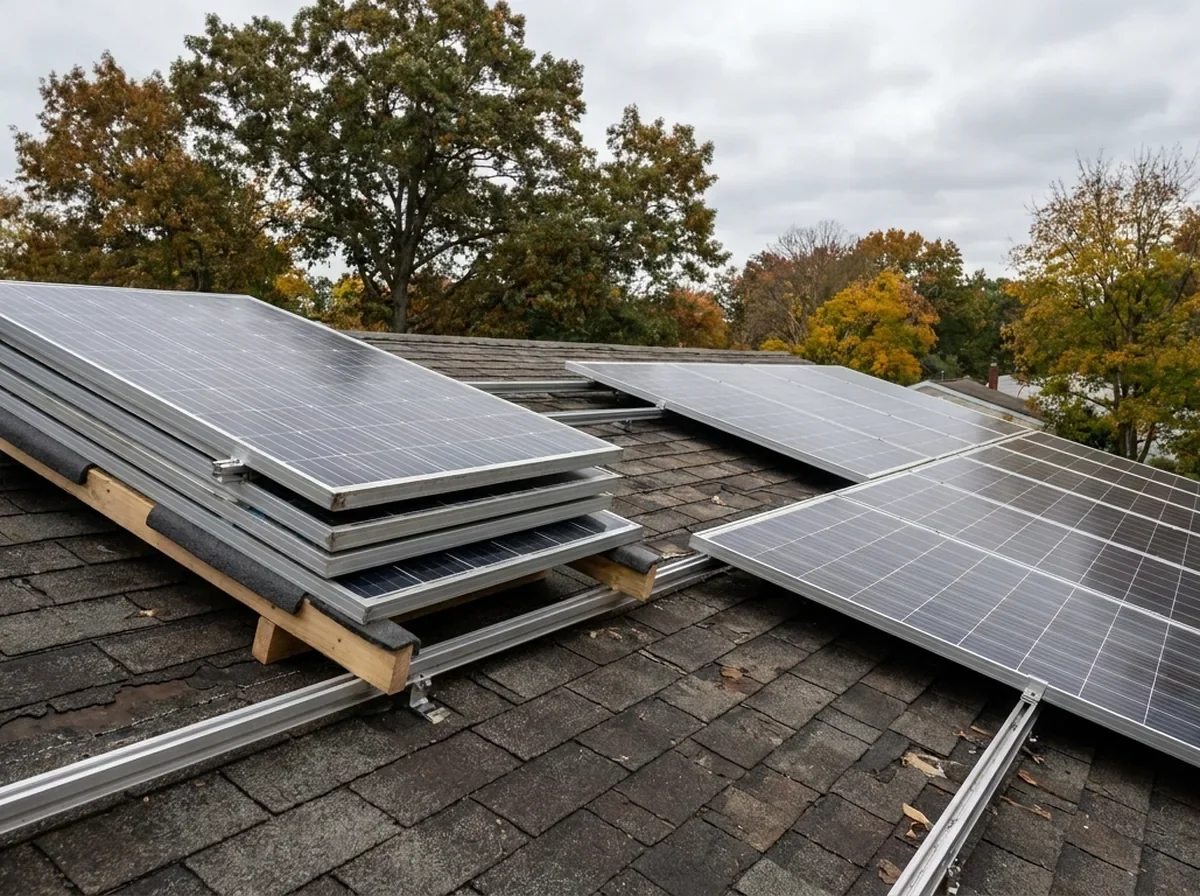
If there is an array on the roof -- or about to be -- the sequence is worth roughly five thousand dollars, and nobody selling solar has a reason to mention it.
Removal and reinstallation is $250 to $350 per panel in New Jersey. That is $4,500 to $9,500 on a normal system -- a five-figure line on a five-figure job. A roofing quote that does not mention the array has not priced the work you actually need.
Because the decision is no longer free, it is a schedule. Knowing the covering has three years rather than ten lets you plan the removal around it -- and lets you do any other roof work on the property in the same window.
On the roof itself the usual test applies: if the covering away from a leak still lies flat, holds its granules and is not brittle, the repair is the right job at $350 to $1,800 rather than a replacement at $9,500 and up.
Arrays are rare on the mixed-use stock here, and where one exists it is usually a flat-roof ballasted system rather than a pitched roof-mount.
Where there is a pitched slope in the center it is usually a small street-facing section in front of a much larger flat roof.
In the center the flat roof is the whole roof, behind a street parapet with internal drainage.
The older commercial frontages are the historic stock in the center, and what matters on them is the parapet and the cornice rather than the field of the roof.
Detached garages are scarce in the center; where a property has covered parking it is more often a bay under the building or a flat roof over a rear service area.
Detached township stock. Count the panels first.
Pre-1940. Board sheathing and no ice barrier.
The biggest roofs, and the biggest arrays on them.
An 1895 planned district. Appearance is the brief.
Big Victorian roofs, and slate on a fair number.
Denser and more multi-family. Unit count decides it.
Sloping plots, ambitious shapes. Detail, not area.
Asked on every job of this kind. Answered here.
Only where it has actually softened, and as a rate per sheet in the written scope rather than a lump guess. On pre-war housing the deck is frequently board sheathing rather than plywood, which holds a nail differently -- so it is established by looking before anything is specified on top of it.
Only on one existing layer with a sound deck. Two coverings is the practical ceiling, and an overlay buries the eaves detail -- so if there was never an ice barrier down there, an overlay guarantees there still is not. In this climate that is the wrong saving.
Before, if the covering has less than about fifteen years left. The removal and reinstallation cost -- $4,500 to $9,500 -- simply does not happen if the roof is already new when the array goes on. Doing it the other way round means paying a second set of trades to undo work finished the year before, and nobody selling solar has a reason to raise it.
An architectural asphalt roof runs $9,500 to $26,000, with most 2,000 square foot houses at $12,000 to $18,000 installed. Per square foot that is $5.50 to $8.00 for architectural and $4.50 to $6.50 for three-tab. If there is a solar array on the roof, add $4,500 to $9,500 and four to seven days.
It might, and we find out rather than guess. Halcyon Park was laid out in 1895 as a planned community and is a historic district; New Jersey municipalities may operate a historic preservation commission whose approval is needed for exterior changes. Whether that applies to a roof here is confirmed with the township before the work is booked.
Any array counted and priced separately, not buried in a rate. Both sequences costed, so the cheaper order is obvious.