Solar Panel Roof Replacement in Bloomfield from $250. $250 to $350 a panel to take the array off and put it back -- and the order you do things in is worth $5,000. Free inspection and a written quote.
$250 to $350 per panel to take the array off and reinstall it, four to seven days with the system down, and one question worth five thousand dollars: are the panels already on, or about to go on? If they are about to, and the roof has a decade left, replace the roof first and the removal cost never happens.
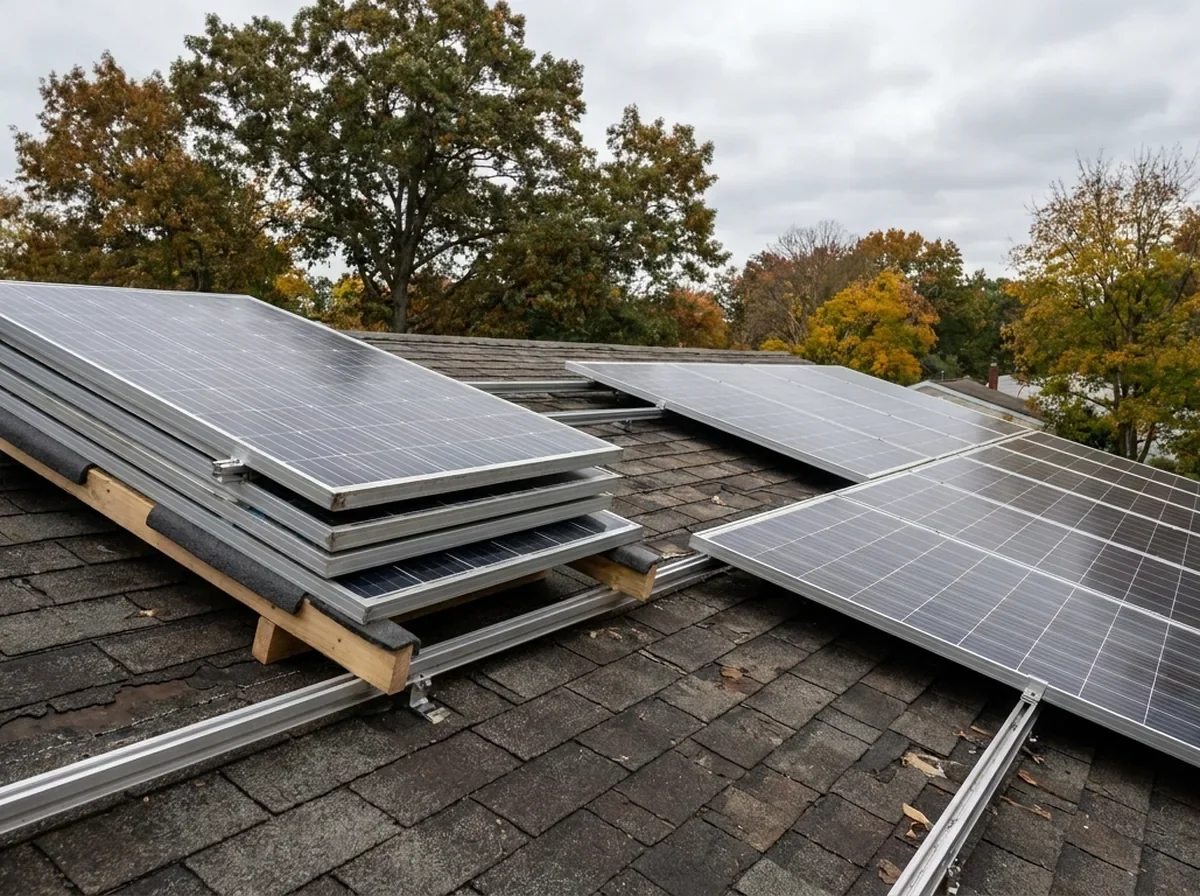
Removing a solar array so the roof under it can be replaced, and reinstalling it afterwards, costs $250 to $350 per panel in New Jersey. On a 26-panel system that is roughly $5,000 to $6,500, and across the normal range of residential systems $4,500 to $9,500. It adds four to seven days: a day to take the array down, two to five days of roofing, a day to put it back.


Removing a solar array so the roof underneath can be replaced, and reinstalling it afterwards, costs $250 to $350 per panel in New Jersey -- roughly $5,000 to $6,500 on a 26-panel system and $4,500 to $9,500 across the normal range of residential systems. It adds a day off, two to five days of roofing, and a day back. Locally the panel count moves a quote further than anything about the covering: $250 to $350 each, on a system of any size. After that it is the age of the house, because board sheathing has to be made good rather than nailed into and plywood does not.
If the covering has ten years left and the panels have not gone on yet, replace the roof first: the removal cost never happens. Doing it the other way round means paying five figures' worth of trades to undo work finished the year before.
Electrical disconnect, removal and labeling, secure storage while the roof is open, reinstallation on the new covering, reconnection, and a production check afterwards. A quote that does not list those has not scoped the work.
Panel count, because the price scales with panels and not roof area. A complicated roof where the mounting is spread across planes rather than run in clean rows. And a ballasted flat-roof system, which comes off differently from a pitched roof-mount.
Two things decide a Bloomfield job. Whether there is a solar array on the roof, which moves the price by $4,500 to $9,500 and is left out of most quotes entirely. And the age of the house, because board sheathing and plywood are not the same job and the older stock here has the former.
Bloomfield is detached enough that a roof replacement is usually ordinary maintenance with no permit at all -- which is the opposite of the dense cities a few miles south.
The part almost nobody is told is that the ORDER matters enormously. If your roof has a decade left and you are about to have panels fitted, replacing the roof first costs you nothing extra -- the crew is coming anyway. Doing it in the other order means paying five thousand dollars or more to undo work that was finished the year before.
If there is an array on the roof -- or about to be -- the sequence is worth roughly five thousand dollars, and nobody selling solar has a reason to mention it.
A covering with ten years left under panels about to be fitted should be replaced now, while the removal cost is zero. Do it in the other order and you pay a second set of trades to undo work finished the year before. This is the single most valuable sentence on this site.
Because the decision is no longer free, it is a schedule. Knowing the covering has three years rather than ten lets you plan the removal around it -- and lets you do any other roof work on the property in the same window.
On the roof itself the usual test applies: if the covering away from a leak still lies flat, holds its granules and is not brittle, the repair is the right job at $350 to $1,800 rather than a replacement at $9,500 and up.
Count the panels before you compare quotes.
Architectural at $5.50 to $8.00 per square foot against three-tab at $4.50 to $6.50 -- a few thousand dollars on an average township roof, and worth paying on a house you intend to keep.
Flat roofing here is usually a rear addition, a porch roof or a dormer top rather than a whole building, at $5 to $14 per square foot by system.
Older housing across the township brings board sheathing rather than plywood, original eaves detailing and roof shapes with more valleys per square foot than modern work.
A detached garage carries the oldest covering on most properties in this township and the least inspected.
Mixed use, flat roofs, parapets. Access first.
Pre-1940. Board sheathing and no ice barrier.
The biggest roofs, and the biggest arrays on them.
An 1895 planned district. Appearance is the brief.
Big Victorian roofs, and slate on a fair number.
Denser and more multi-family. Unit count decides it.
Sloping plots, ambitious shapes. Detail, not area.
Asked on every job of this kind. Answered here.
On a small localized repair, sometimes. On a replacement, no -- the covering under the array has to come off, and that means the array comes off. Anybody offering to re-roof under panels in place is describing something other than a replacement.
A qualified electrician, not us. We do roofing. The removal price includes coordinating it and the production check afterwards, but the electrical work itself is a separate trade and the scope says so rather than blurring it.
$250 to $350 per panel in New Jersey -- roughly $5,000 to $6,500 on a 26-panel system and $4,500 to $9,500 across the normal range of residential systems. That covers the electrical disconnect, removal and labeling, storage while the roof is open, reinstallation, reconnection and a production check. It adds four to seven days to the job.
Before, if the covering has less than about fifteen years left. The removal and reinstallation cost -- $4,500 to $9,500 -- simply does not happen if the roof is already new when the array goes on. Doing it the other way round means paying a second set of trades to undo work finished the year before, and nobody selling solar has a reason to raise it.
Usually not. Replacing the covering on a DETACHED one- or two-family dwelling is ordinary maintenance under N.J.A.C. 5:23-2.7 -- no permit, no notice, no inspection -- and in a township of detached houses that is the normal answer. Three or more units, an attached building or anything structural is different, and we confirm it at the survey.
Any array counted and priced separately, not buried in a rate. Both sequences costed, so the cheaper order is obvious.